
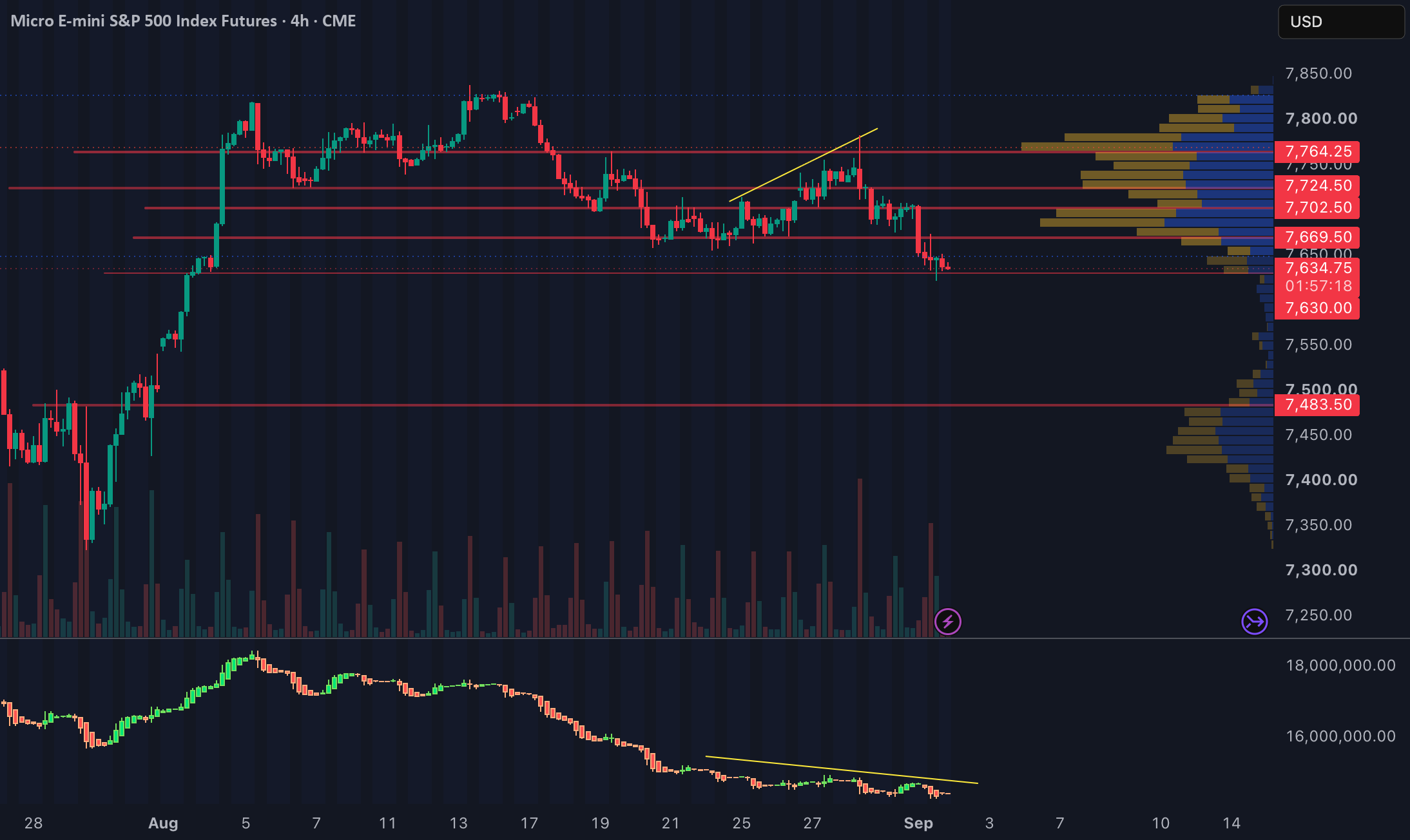
Tactical Risk-Off Confirmed — MES Loses 7,670 and Rejects the Retest
Market Regime: Tactical Risk-Off / Downside Continuation
Systemic Stress: Not confirmed
Confidence: High
Tuesday strengthened the market’s risk-off structure. The decisive development was MES losing the 7,680–7,670 area, accepting below it, and then cleanly rejecting a recovery attempt back into former support.
That failed retest carries more weight than the opening decline itself. Buyers were given an opportunity to repair the breakdown, but sellers defended the broken zone.
Breadth and Internals
The decline received broad confirmation:
RTY rejected the 2,965 HVN shelf and broke into lower value.
RSP lost its LVN boundary, confirming weakness beyond capitalization-weighted indices.
ADD finished near –1,142.
TICK was approximately –471 late in the review.
Down volume exceeded up volume.
All five S5 breadth gauges moved sharply lower.
XLF, KRE and XLY weakened alongside semiconductors.
VIX and VIX1D strengthened.
This was not an isolated decline driven by one or two megacaps. Small caps, equal weight, cyclicals, financials and global indices participated.
Technology and Leadership
Technology is damaged but not completely abandoned.
SOX and SMH remain weak, while AMD and AMZN are trading in vulnerable profile areas. NVDA is testing a crucial HVN/LVN shelf, but its shorter-term CVD is improving. MNQ’s 65-minute CVD is also holding up better than price.
That could represent absorption, but price has not confirmed a reversal. The 15-minute MNQ structure remains bearish, and the broader semiconductor complex is still weak.
AAPL remains the clearest relative leader after leaving its LVN and holding the upper HVN. META and MSFT are comparatively resilient, while AVGO is attempting to stabilize around its HVN.
Rates, Volatility and Credit
Treasury yields rose across the curve, with pressure increasing toward the long end. That resembles term-premium or long-duration pressure more than a sudden front-end policy shock.
TLT CVD is strengthening despite weak price, while TNX made a higher high with weaker RSI momentum. These are early bond-absorption signals, but neither has received price confirmation.
VIX and VX strengthened, confirming risk aversion, but the volatility curve remains in contango.
Credit and funding markets are the primary counterevidence against a systemic-risk call:
HYG/LQD remain relatively orderly.
Fed plumbing has not shown an acute break.
SOFR at 3.68 warrants monitoring but does not independently indicate funding stress.
There is no clear credit transmission into disorder.
Key MES Levels
Support:
7,628.50 — immediate decision level
Approximately 7,600 — intermediate structure
7,554.00 — next major lower shelf
Resistance:
7,660.75–7,667.25 — first reclaim band
7,680.75 — principal repair pivot
7,691.75–7,700.00 — balance area
7,716.25–7,724.25 — stronger bullish repair
Key MNQ Levels
29,000–29,095 — immediate support/decision area
29,169.75–29,212.75 — first reclaim band
29,288.75 — secondary repair
29,413.75–29,468.00 — stronger resistance
28,635.25 — major lower shelf if current support fails
Wednesday’s Primary Question
Can MES defend 7,628.50 and reclaim 7,660.75–7,680.75 with improving breadth, semiconductors and CVD?
If yes, Tuesday’s breakdown may begin repairing.
If MES accepts below 7,628.50 while internals remain weak and volatility stays firm, the thinner-volume path toward 7,554 becomes increasingly relevant.
For now, rallies below 7,680.75 remain repair attempts—not confirmation that the tactical risk-off regime has ended.