
Grid Under Pressure Heat Waves AI Demand And Rate Bets Collide
Sector rotation has been a key theme for the utilities sector in recent weeks. The S&P 500 is trading near record levels, and with risk appetite still strong, investors have generally favored cyclical and growth oriented sectors over defensive ones. Despite this backdrop, utilities have still managed to attract steady inflows. This is because the sector plays two roles at once. It is a classic defensive, rate sensitive trade, and it is also a direct beneficiary of rising AI driven power demand, which gives it a growth angle that other defensive sectors lack. This rotation debate has been reinforced by fundamentals. Q2 earnings season for the sector began the week of July 15, with analysts expecting year over year growth of roughly 13.4%, the fourth highest among the eleven S&P 500 sectors. Meanwhile, record summer heat has strained the grid, with PJM peak load surpassing last year’s record by about 2 GW on July 2, and real time power prices spiking to nearly $350 per megawatt hour that week versus a year to date average closer to $64. On the macro side, the Fed is expected to hold rates steady at its July 28 to 29 meeting, with markets leaning toward a possible cut in September, a factor that could accelerate rotation back into the sector if it materializes.
What The Market Has Done
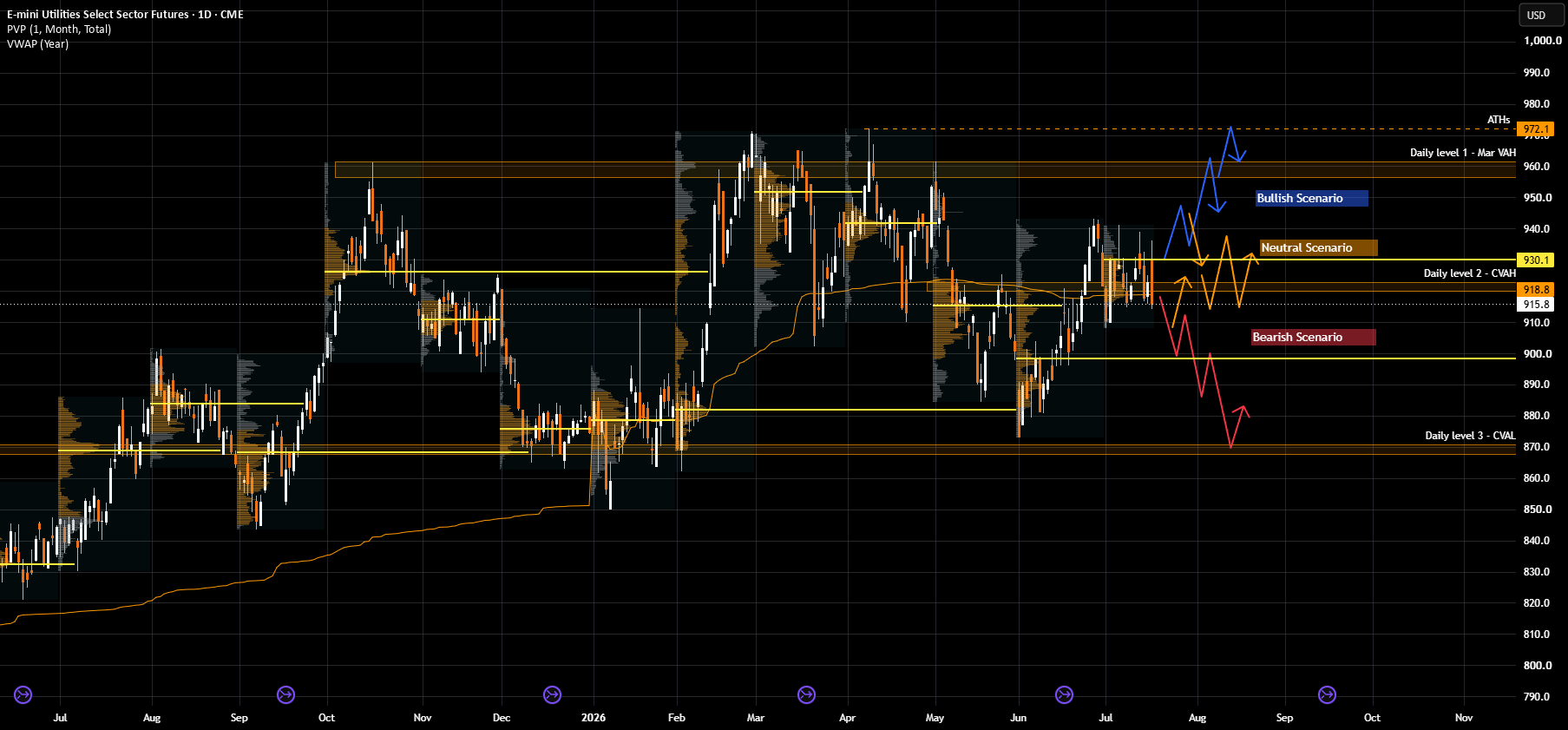
- The market has been in a larger sideways consolidation range between 960 (Daily level 1) and 870 (Daily level 3) since October 2025.
- It was able to hold above yearly VWAP from the start of the year until the first week of May.
- Sellers then took control and offered prices below 918, a level confluent with yearly VWAP.
- Prices moved down toward the 870 area (Daily level 3), where buyers responded.
- Toward the end of June, buyers regained control of yearly VWAP and reclaimed prices back above it.
- Since then, buyers have successfully defended yearly VWAP against sellers, who have stepped their offers down to the 940 area and are pressuring the market lower.
- What To Expect In The Coming Weeks
- The key level to watch is the 915 to 918 area (Daily level 2, CVAH), which is confluent with yearly VWAP.
Neutral Scenario
- Expect continued two way battle within the current July value area, with buyers holding bids near 915 while sellers defend offers around 940.
- The possible condition that will support this scenario is a mixed Q2 earnings season combined with a Fed meeting on July 28 to 29 that delivers no new guidance, leaving the market without a clear directional catalyst.
Bullish Scenario
- If buyers defend the 915 area and the market breaks and accepts above 940, expect a move up toward the 960 area (Daily level 1, March VAH), where responsive sellers are likely.
- If that level fails to hold buyers, a further move toward 972.1 (all time highs) becomes possible.
- A potential trigger includes stronger than expected utility earnings paired with dovish Fed commentary or an early signal of a September rate cut, along with continued elevated power demand from AI data centers and grid strain. A broader rotation out of high flying growth and cyclical names and into defensive, income generating sectors could reinforce this move, particularly if risk appetite in the broader market begins to fade.
Bearish Scenario
- If buyers fail to hold bids at the 915 area, expect a move down toward the 900 area (June VPOC), where some responsive buying is likely.
- If that fails to hold, expect a further move down toward 870 (Daily level 3, CVAL).
- A potential trigger includes a hawkish surprise from the Fed, a sharper than expected rise in the 10 year Treasury yield, weak utility earnings guidance, or an escalation in geopolitical tension that pushes oil prices and inflation expectations higher. Continued strong risk appetite and sustained rotation into cyclicals and growth sectors at the expense of defensives could also keep pressure on the utilities sector even if earnings come in solid.
Conclusion
Technically, the utilities sector remains anchored at a pivotal decision point around 915 to 918, where yearly VWAP and recent buyer defense have kept the broader range between 870 and 960 intact. Fundamentally, the sector’s dual identity as both a defensive, rate sensitive trade and a growth linked AI power demand story continues to make it a natural destination for rotation flows, even as strong Q2 earnings and elevated grid demand support the longer term case. Traders should watch how price reacts around 915 in the sessions ahead, since a clean break in either direction could define whether rotation into utilities accelerates or stalls. What is your read on this range, is 915 the level that holds, or does this turn into a deeper pullback first?
Disclaimer: Past performance is not necessarily indicative of future results. Trading futures involves substantial risk of loss and is not appropriate for all investors. This content is intended for informational and educational purposes only and does not constitute trading advice or a solicitation to buy or sell any futures contract. Trade your own plan and manage risk.
Acronyms:
C – Composite
w – Weekly
m – Monthly
VA – Value Area
VAH – Value Area High
VAL – Value Area Low
VPOC – Volume Point of Control
LVN – Low Value Node
LVA – Low Value Area
HVN – High Value Node
HVA – High Value Area
SP – Single print
ATH – All time high