
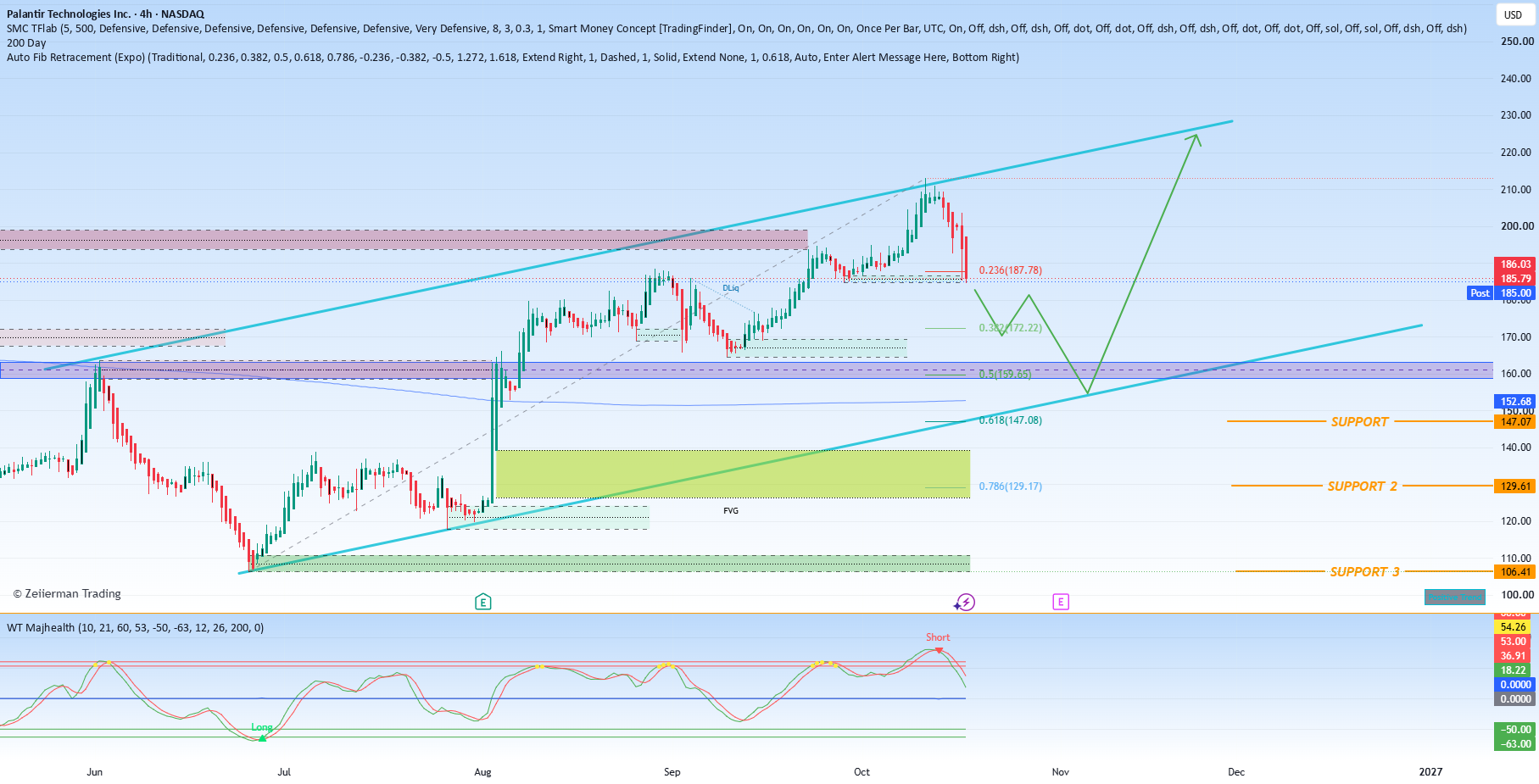
Palantir Technologies was setting records earlier this week. By Friday, that breakout had completely reversed, with the stock heading toward correction territory and dragging a broad swath of the software sector down with it. The turn has been swift and brutal, and it offers a vivid illustration of how quickly momentum can shift in a market that had spent months rewarding the same names it is now punishing.
A Correction in the Making
Shares of Palantir fell roughly 7% on Friday, erasing about $34 billion in market value in a single session. The closing number to watch is $188.15. If the stock finishes below that level, it would end the day more than 10% beneath its October 9 record close, confirming a correction according to Yahoo Finance calculations. That threshold matters because a 10% decline from a recent peak is the conventional definition of a correction, and crossing it often triggers a shift in how both institutional and retail investors view the stock.
The speed of the reversal is what makes it so striking. It took nearly a year for Palantir to reclaim its old record, and the victory lasted just three trading sessions. The stock closed above its November 2025 intraday high near $208 last Friday, then climbed to nearly $213 on Monday. By Wednesday, it had already fallen back below the old ceiling. Friday’s early move above $203 gave way to another retreat, capping a week in which the stock surrendered nearly all of its recent gains.
What a Bull Trap Looks Like
Technically, the pattern Palantir just experienced is known as a bull trap. A bull trap occurs when a stock breaks above a key resistance level, drawing in buyers who interpret the breakout as a signal of continued strength, only for the price to reverse and fall back below that level. The investors who chased the breakout are left nursing losses, and the failed move can damage sentiment because it undermines confidence in the stock’s ability to sustain higher prices.
In Palantir’s case, the resistance level was the November 2025 intraday high near $208, a ceiling the stock had struggled to overcome for nearly a year. When it finally broke through last Friday and extended to nearly $213 on Monday, it looked like a genuine breakout that would open the door to further gains. Instead, the move proved unsustainable, and by Wednesday the stock was back below the old ceiling. That failure is significant because it suggests that sellers remain active at higher prices, and it may take considerable new buying pressure to push the stock back toward its record.
The Broader Software Selloff
Palantir’s decline did not occur in isolation. Software stocks as a group shed roughly $260 billion in market value, a figure that underscores how widespread the selling pressure has become. When an entire sector sells off together, it usually reflects a macro-level reassessment rather than company-specific news. Investors may be rotating out of high-multiple software names in response to changing rate expectations, concerns about valuations, or a broader shift in risk appetite.
For Palantir specifically, the selloff comes after a period of extraordinary outperformance. Over the past month, Palantir stock had gained 16%, a run that left the rest of enterprise software well behind. That kind of relative strength tends to attract momentum buyers, but it also makes the stock more vulnerable to sharp reversals when sentiment turns. The bigger the run-up, the more profit-taking there is to absorb when the trend breaks.
Take Profits, or Buy More?
The pullback raises a question that every Palantir holder now has to confront: should they lock in gains, or add to their position? The stock is down about 4% to $201.31, and that decline could clarify the choice between taking profits and buying more. For investors who bought early and rode the stock through its remarkable ascent, the temptation to realize gains is understandable. For those who believe the company’s long-term prospects remain intact, the dip may look like an opportunity.
The month-long advance in Palantir stock leaves investors weighing how large their share position really ought to be. This is a question about portfolio construction as much as it is about conviction. A stock that has surged 16% in a month can quickly become an outsized portion of a portfolio, and rebalancing after a big run is a disciplined way to manage risk without abandoning the thesis entirely. Conversely, investors with high conviction and a long time horizon may view short-term volatility as noise rather than signal.
The Government-Contract Thesis
Palantir’s investment case rests heavily on its government contracts, which provide a stable revenue base that many enterprise software companies lack. Government customers tend to sign long-term agreements, renew at high rates, and pay reliably, all of which makes the revenue stream more predictable than commercial deals that can be canceled or delayed. That predictability is a genuine advantage, particularly in an environment where investors are growing more cautious about speculative growth stories.
At the same time, the government-contract-driven thesis has limits. Government procurement cycles can be slow, contract awards can be delayed or contested, and reliance on a relatively concentrated customer base introduces its own risks. The stock’s valuation has also been a persistent point of debate, with critics arguing that the share price embeds expectations that are difficult to justify even under optimistic assumptions about future growth.
What Comes Next
The immediate question is whether Palantir can stabilize above the $188.15 level or whether further declines are in store. A close below that threshold would confirm the correction and could invite additional selling as momentum-focused investors exit. A hold above it would suggest that buyers are stepping in at these levels, which would be an encouraging sign for the bulls.
Beyond the technical picture, investors should watch for any company-specific news that might explain or counteract the selloff, as well as broader signals about interest rates and risk appetite that are driving the software sector’s decline. The $260 billion in value shed across software stocks suggests this is not simply a Palantir story but part of a wider repricing. How long that repricing lasts, and where it settles, will determine whether Friday’s decline looks in retrospect like a buying opportunity or the beginning of something more sustained.